

Washington reissues sweeping regional travel warnings following intercepted Houthi missile strike over Riyadh and fresh terms delivered via Qatar.
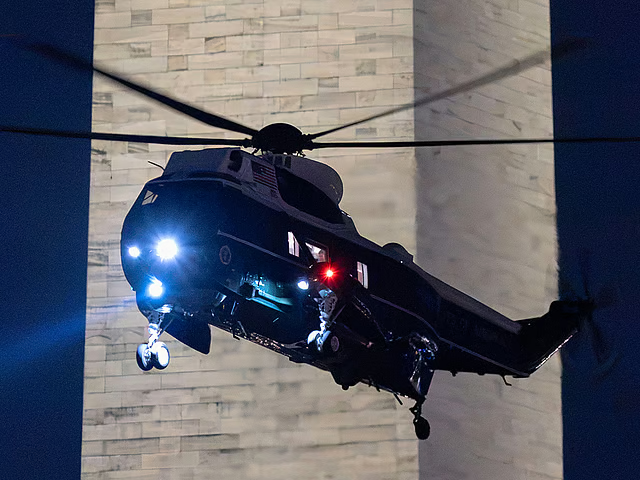
WASHINGTON/RIYADH — September 20, 2026 : U.S. President Donald Trump abruptly cut short his weekend at Camp David and returned to the White House on Saturday as regional hostilities widened, hours after Saudi air defense units intercepted a ballistic missile launched toward Riyadh by Yemen’s Houthi movement.
The White House offered no immediate explanation for Trump’s early departure from the presidential retreat in rural Maryland, where he had originally been scheduled to remain through Sunday. The sudden schedule change followed a rapid sequence of military escalations across multiple fronts, punctuated by fresh diplomatic signaling from Tehran and urgent travel warnings from the U.S. State Department.
Saudi defense authorities confirmed their forces intercepted a Houthi-fired ballistic missile aimed at the capital at dawn. Residents in northern Riyadh reported hearing loud blasts, with plumes of smoke observed near King Khalid International Airport. Saudi military officials reported no casualties or structural damage from falling debris.

Saudi authorities also stated that separate aerial attacks targeting critical infrastructure in the Red Sea port city of Yanbu—the terminal hub for Saudi Arabia’s East-West crude pipeline—as well as sites in Taif, Baysh, and Farasan, were successfully thwarted. Houthi military spokesmen claimed they had hit “sensitive sites” in the capital and struck Saudi Aramco facilities in Yanbu. Aramco did not issue a public comment.
Diplomatic channels showed parallel movement. Mohsen Rezaei, secretary of Iran’s Supreme National Security Council, told Al Jazeera that Tehran has transmitted its conditions for halting the war to Washington through Qatari intermediaries and is awaiting a formal response from Trump.
According to Rezaei, Tehran’s framework demands an immediate cessation of military operations on all fronts, the unfreezing of seized Iranian assets abroad, an end to the U.S. naval blockade restricting access to Iranian commercial ports, and a comprehensive halt to cross-border hostilities between Yemen and Saudi Arabia.
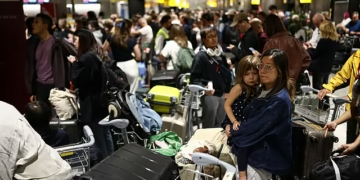
The diplomatic overture follows the collapse of earlier direct and mediated discussions between Washington and Tehran. In Washington, the State Department renewed a blanket regional security alert, advising American citizens outside the Middle East to reconsider all travel to and through the region.
“This military conflict has the potential to escalate rapidly,” the State Department advisory stated, citing recurring projectile attacks on civilian infrastructure and airports by Iranian-backed groups. At least 11 U.S. embassies across the region issued localized security notices warning of possible air traffic disruptions and border closures.
The confrontation continues to unfold against ongoing Israeli aerial bombardments in southern Lebanon and the Gaza Strip, alongside heightened monitoring of commercial tanker transit across the Strait of Hormuz, where international energy flows remain vulnerable to maritime skirmishes.