

Investigators examine how a combined wave of low-altitude drones and manoeuvrable missiles bypassed Patriot batteries across a 1,000-kilometre corridor.
RIYADH — October 13, 2026 : Saudi military investigators are examining how an armed barrage launched by Yemen’s Houthi movement travelled over 1,000 kilometres to strike King Khalid International Airport in Riyadh, evading sophisticated multi-layered air defence batteries and killing at least 13 people.
The strike on the capital’s primary civilian hub wounded more than 300 people, marking the deadliest single breach of Saudi airspace since cross-border hostilities intensified. Regional security officials familiar with the initial inquiry confirmed that the assault combined autonomous attack drones with cruise missiles and ballistic projectiles carrying manoeuvrable warheads.
Military analysts assessing the incident say the salvo was engineered to confuse radar tracking systems. Drones launched ahead of the primary strike flew along low radar corridors, forcing regional sensors to track multiple slow-moving targets. Moments later, high-speed cruise missiles flying beneath radar horizons and ballistic missiles descending along erratic trajectories struck the airfield perimeter.

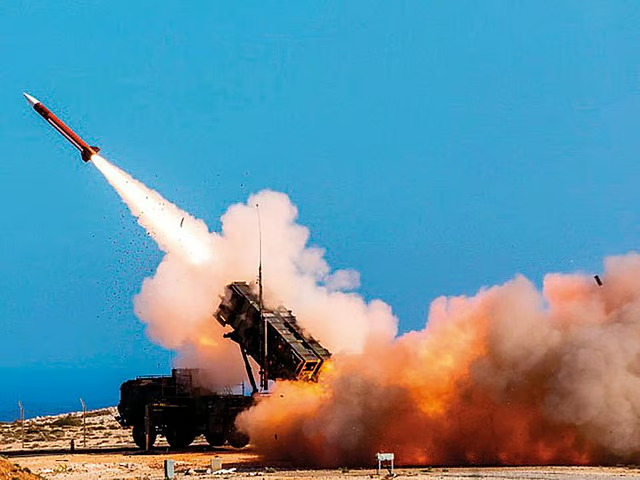
The sequence exposed critical operational vulnerabilities in defending against integrated aerial salvos. Saudi Arabia relies heavily on United States-manufactured MIM-104 Patriot batteries, long regarded as a primary shield against tactical ballistic missiles across the Arabian Peninsula. While Patriot systems have shot down hundreds of incoming projectiles over the past decade, technical limitations arise when radar systems face mixed-altitude swarms arriving from divergent angles.
Traditional ballistic missiles travel along fixed, parabolic flight paths that automated radar algorithms calculate with precision. In this incident, evidence indicates the Houthis deployed missiles equipped with manoeuvrable re-entry vehicles (MaRVs). These warheads shift trajectory during atmospheric descent, reducing the window interceptor batteries have to lock onto targets before impact.
Terrain-hugging cruise missiles compounded the detection failure. By navigating desert valleys at tree-top height, such munitions reduce radar return signals and exploit natural dead zones in ground-based detection nets. Combined with suicide drones built with minimal radar cross-sections, the attack saturated the early-warning umbrella protecting the Riyadh metropolitan area.
The scale of the breach has raised alarms in Washington and Gulf capitals regarding the rapid evolution of Houthi military hardware. Once reliant on unguided tactical rockets and captured Yemeni army stockpiles, the group has developed long-range precision capabilities with technical assistance, components, and training provided by Iran.
The security crisis is also driving diplomatic friction. Riyadh has pushed the United States to take direct military action against launch facilities and missile depots inside Houthi-controlled northern Yemen. While Washington has shared targeting intelligence and operational tracking data, American forces have largely avoided offensive strikes in the latest round of fighting.
That restraint may shift. President Donald Trump stated over the weekend that the administration is weighing military options in response to the airport casualties. Direct American involvement risks reigniting wider maritime hostilities around the Bab al-Mandeb Strait, where commercial shipping routes into the Red Sea remain vulnerable to shore-based anti-ship fire.
Saudi military planners are reviewing radar placements, sensor fusion between regional command centres, and early-warning tripwires surrounding critical national infrastructure. The strike demonstrates that even the most advanced air defence systems can be compromised when adversaries deploy layered, asymmetrical arsenals designed to overwhelm automated warning networks.