

UAE presidential adviser calls for direct Gulf-Tehran negotiations alongside Washington talks, stressing deterrence paved the way for political engagement
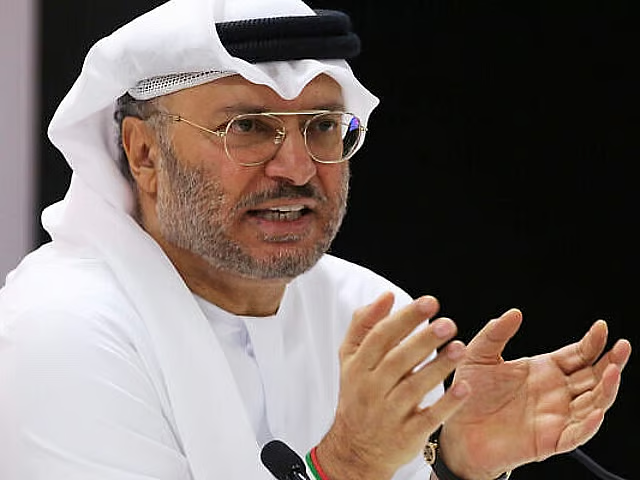
DUBAI, Sept. 25 : Any resolution to the ongoing regional confrontation with Iran must establish enduring stability rather than a fragile, temporary lull, Anwar Gargash, Diplomatic Adviser to UAE President Sheikh Mohamed bin Zayed Al Nahyan, warned, urging direct Gulf-Tehran dialogue alongside US-led negotiations.
DUBAI — A lasting political settlement with Tehran cannot rely solely on agreements struck between Washington and Iran, Dr Anwar Gargash, Diplomatic Adviser to the UAE President, said in an interview with Foreign Affairs.
Speaking seven months into the wider conflict that broke out on February 28, Gargash stressed that short-term compromises would merely invite renewed fighting within months. Sustainable peace, he argued, requires structured, high-level diplomatic tracks involving Gulf Cooperation Council member states—both collectively and bilaterally—to lay down basic frameworks for non-belligerence and confidence-building.

“We do need peace, but I think also we need peace that will last,” Gargash said. “We don’t need, you know, sort of a patch-up job where suddenly within three months, four months, five months, we have another outbreak.”
The UAE warned its international partners against military action from the outset, anticipating that direct conflict would prove protracted, volatile, and difficult to isolate. While Abu Dhabi anticipated retaliatory hostility once strikes began, Gargash acknowledged that the sheer scale and persistence of Iranian strikes across the Gulf exceeded initial expectations.
According to Gargash, Iran launched approximately 3,300 missiles and drones at the UAE, with 95% directed toward civilian infrastructure. UAE air defence systems intercepted well into the high 90th percentile of those incoming projectiles.
Gargash framed the hostilities as two parallel conflicts: an American-Israeli military campaign against Iran, and an aggressive Iranian campaign against Gulf states. He stated that the UAE had worked systematically to separate these tracks conceptually and diplomatically.
Effective deterrence, Gargash noted, served as the essential foundation that now allows room for diplomatic overtures.
“Establishing deterrence is not a goal in of itself,” he said. “Establishing deterrence is an important element that now today is leading us to greater opportunities with diplomacy.”
While formal diplomatic ties may resume out of practical necessity, Gargash observed that Tehran’s cross-border attacks shattered baseline trust across the region, creating a rift that will take years to mend. Future relations will likely begin on purely functional terms rather than strategic partnership.
Addressing regional security architecture, Gargash affirmed that the United States remains indispensable to Gulf security, though regional capitals can no longer presume US military assets exist purely for their unilateral defense.
“American boots and American power is not going to defend the region. American boots and American power will look after American interests,” he noted.
Consequently, the UAE continues to balance self-reliant defense capabilities with a foreign policy rooted in strategic autonomy. This posture includes courting Asian economic partners and encouraging Beijing to leverage its diplomatic weight with Tehran while helping safeguard key shipping channels through the Strait of Hormuz.
Turning to bilateral ties with Riyadh, Gargash addressed recent policy friction between the UAE and Saudi Arabia, describing the current relationship as “not in its best form.” However, he dismissed notions of a zero-sum economic rivalry between Saudi Vision 2030 and the UAE’s open commercial model. Both nations share indivisible security interests, he said, noting that differences are being actively managed to keep economic competition constructive.
On the broader regional picture, Gargash reaffirmed the UAE’s commitment to an independent Palestinian state under a two-state framework alongside comprehensive governance reform within the Palestinian Authority. He noted that Abu Dhabi utilized its diplomatic communication lines with Israel to facilitate close to $4 billion in humanitarian aid into Gaza.
Gargash reiterated that regional security ultimately depends on shifting the Middle East away from security pacts and toward economic integration, trade liberalization, and shared prosperity.