

NATS report rules out cyberattack after radar code failure caused travel chaos across Britain and disrupted Gulf carrier routes
LONDON — September 19, 2026 : A dormant computer coding defect triggered in the space of a single millisecond caused the air traffic control meltdown that grounded more than 2,100 flights across the United Kingdom earlier this month, an official preliminary inquiry revealed.
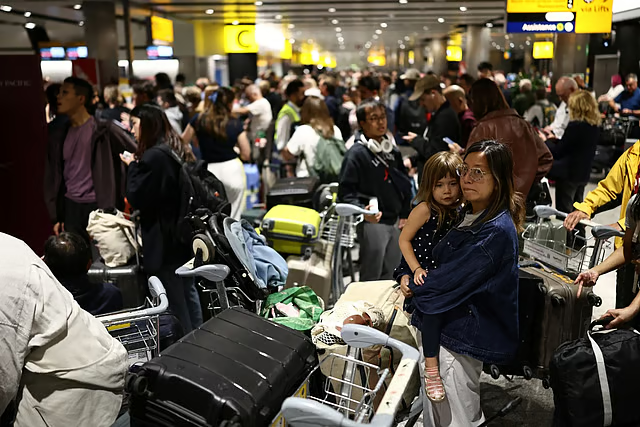
The technical failure on September 8 affected upwards of 330,000 passengers across major British hubs, forcing manual interventions, cascading ground stops, and international flight diversions that reached as far as the United Arab Emirates.
According to an 18-page preliminary investigation published by National Air Traffic Services (NATS), the breakdown originated within a legacy software module in the UK’s National Airspace System (NAS). The module assigns and updates aircraft “squawk codes”—the distinct transponder signals air traffic controllers use to track altitude, position, and flight plans on radar displays.

Investigators found that the system was processing a routine manual request to allocate a radar identification code when it simultaneously received an interrupt for a higher-priority task. While pausing lower-tier tasks is standard protocol, a coding defect prevented the squawk-code process from resuming properly. The interruption generated corrupted flight data within a single millisecond, breaking the digital data link between the central system and the London Area Control centre at Swanwick.
Deprived of automated radar information, controllers resorted to manual handovers between national and international airspace sectors. Because manual operations drastically increase controller workload, NATS immediately slashed airspace capacity to protect flight safety. Ground stops halted departures across London Heathrow, Gatwick, Manchester, and Stansted for roughly four and a half cumulative hours during a six-hour operational restriction.
Aviation analytics firm Cirium recorded 1,746 flight cancellations on September 8 and another 399 on September 9 as airlines struggled to recover, bringing the total to 2,145 cancellations. Airline industry association Airlines UK estimated that 155,000 travellers endured outright cancellations and 180,000 suffered severe delays. British Airways alone halted nearly 550 services, stranding about 85,000 passengers.
The disruption quickly spilled into long-haul Gulf corridors. Etihad Airways was forced to cancel its London Heathrow to Abu Dhabi service (EY64), delay EY66, and divert flight EY67 into Paris Charles de Gaulle, leaving downstream service EY68 delayed by hours. Subsequent flights linking Abu Dhabi to London and Manchester also departed behind schedule. Emirates warned travellers across its UK network of widespread scheduling changes and urged passengers to monitor booking notifications before heading to terminals.
NATS chief executive Martin Rolfe ruled out malicious external interference or military involvement.
“This was a software issue in a specific part of our flight data system, that we have traced to a small subsection of coding,” Rolfe said. He added that the glitch was unrelated to the technical failure in August 2023 that stranded 700,000 passengers or a separate radar issue logged in 2025. Rolfe stressed that aircraft separation and passenger safety remained uncompromised throughout.
UK Transport Secretary Heidi Alexander described the disruption as “completely unacceptable” and ordered the Civil Aviation Authority (CAA) to launch an independent inquiry into NATS’ operational resilience, system investment, and regulatory accountability. The CAA review is scheduled for delivery within six months, while NATS will publish its comprehensive major incident report within 60 days.
Airlines reacted furiously to the findings. Ryanair Chief Operations Officer Neal McMahon dismissed the explanation as unacceptable and renewed calls for Rolfe’s resignation, demanding legally enforceable resilience targets. EasyJet Chief Executive Kenton Jarvis stated that airlines could not continuously serve as the “insurer of last resort” for state-backed infrastructure failures.
NATS said temporary engineering fail-safes are currently active to prevent recurrences while a permanent software patch completes safety testing and deployment.