


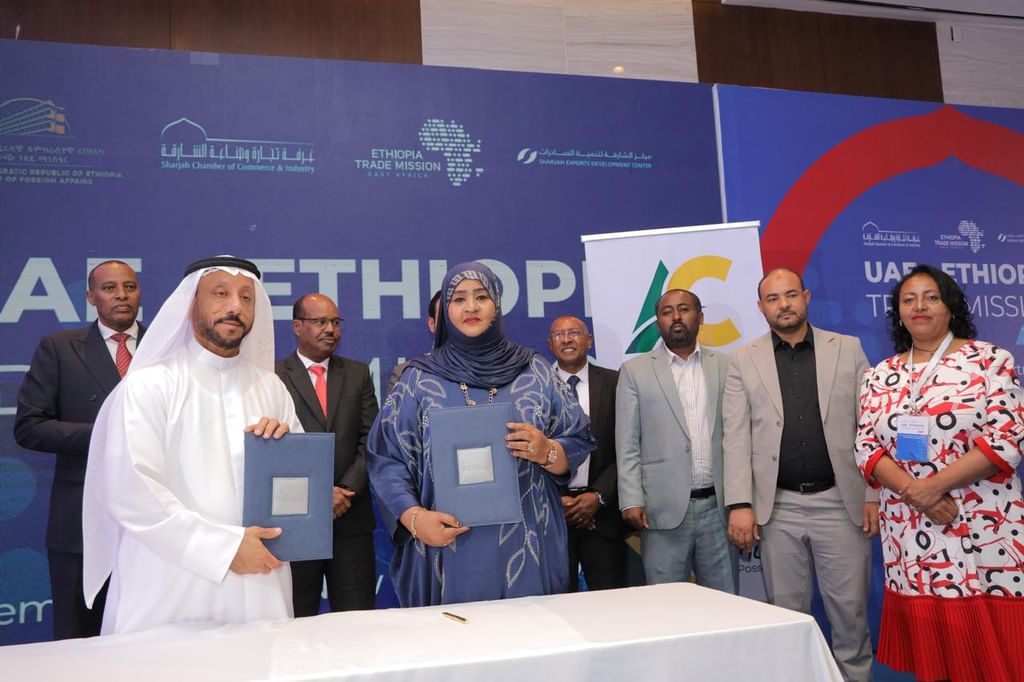
A high-level trade mission targets joint ventures across agriculture, manufacturing, and supply chains, moving bilateral ties beyond conventional commerce.
ADDIS ABABA — October 23, 2026 : The Sharjah Chamber of Commerce and Industry and the Addis Ababa Chamber of Commerce and Sectoral Associations signed a bilateral cooperation pact in the Ethiopian capital, formalizing an initiative to channel Gulf capital directly into East Africa’s manufacturing and agro-processing hubs.
The agreement, finalized during the Sharjah–Ethiopia Business Forum, connects commercial delegations from the United Arab Emirates with more than 140 Ethiopian business leaders. Organized by the Sharjah Export Development Centre (SEDC) under the banner “Fostering New Partnerships and Driving the Future Together,” the mission signals a coordinated push by Gulf investors to secure supply chains and diversify industrial partnerships across the Horn of Africa.

Official trade data presented at the forum highlighted the accelerating economic corridor between the two nations. Bereket Meseret, representing Ethiopia’s Ministry of Trade and Regional Integration, revealed that total bilateral trade between the UAE and Ethiopia reached $5.6 billion across the 2021–2025 period. Emirati shipments made up $4.4 billion of that aggregate, while Ethiopian exports accounted for $1.2 billion. Unroasted coffee remained Ethiopia’s primary export to the Emirates, followed by sesame seeds, chilled meat products, cut flowers, and fresh horticulture.
Abdallah Sultan Al Owais, Chairman of the Sharjah Chamber and head of the delegation, told delegates that established diplomatic and logistical channels now offer a foundation for cross-border private ventures. He noted that Sharjah-based enterprises are looking beyond traditional commodity trading toward equity positions, distribution hubs, and processing facilities in fast-growing African corridors.
Ethiopia’s State Minister of Industry, Hassan Mohammed, urged the visiting delegation to deploy capital into value-added manufacturing, pointing to recent national macroeconomic reforms, low-cost power, and a young workforce. Addressing the plenary, Mohammed outlined priority industrial segments seeking foreign direct investment, including pharmaceuticals, textiles, leather tanning, construction inputs, chemicals, packaging, and agricultural implements. The objective, he emphasized, is to transition from raw commodity extraction to domestic processing, technology transfer, and job creation.
The diplomatic delegation attending the talks included UAE Ambassador to Ethiopia Abdalla Hassan Alshamsi and Dewano Kedir, Director General of Middle East, Asia, and Pacific Affairs at Ethiopia’s Ministry of Foreign Affairs. Both officials underscored that public-sector frameworks are in place to safeguard cross-border capital and expedite commercial permissions.
The newly signed memorandum of understanding outlines mechanisms for business-to-business networking, institutional dispute mitigation, regular exchange of market intelligence, and logistical support for trade missions. Zekarias Assefa, Secretary-General of the Addis Ababa Chamber, stated that direct engagement between private operators remains essential to bridge trade imbalances through counter-investments in Ethiopian agro-logistics, mineral extraction, and renewable infrastructure.
Direct business-to-business sessions concluded the forum, pairing representatives from 10 Sharjah industrial corporations with domestic operators. Negotiations centered on contract packaging, cold-chain transport, agricultural machinery imports, and bulk building material distribution, setting a framework for formalized contracts before the end of the fiscal year.