

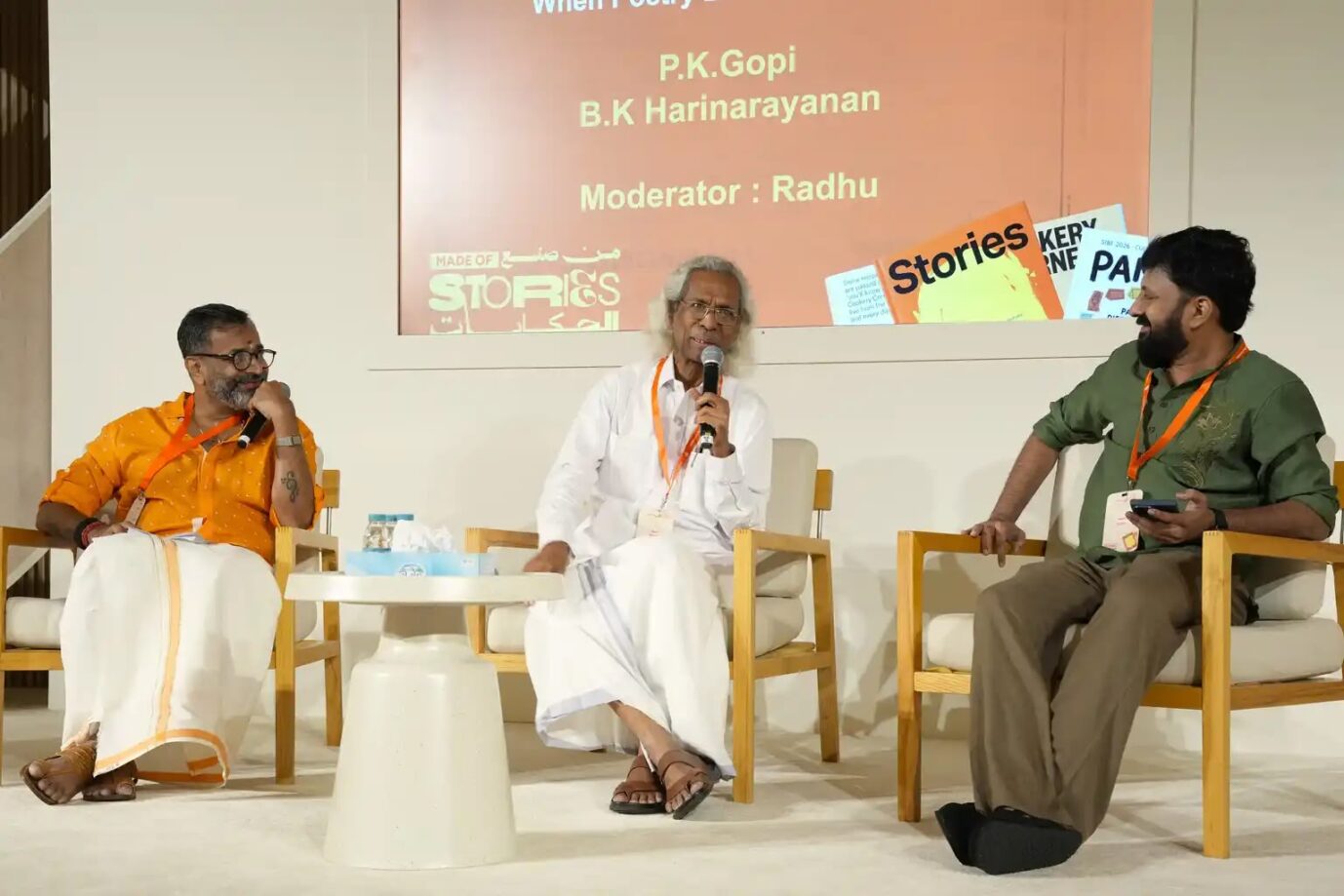
Lyricists explore social realism, poetic evolution, and cultural shifts during literary discussion at Intellectual Hall
SHARJAH, United Arab Emirates — Noted Malayalam poet and lyricist P.K. Gopi offered a fresh sociological interpretation of the classic Malayalam children’s rhyme ‘Kakke Kakke Koodevide’ (Crow, Crow, Where is Your Nest?), stating that the verse reflects humanity’s primary struggle against hunger and the bond between man and nature.
Speaking at a panel discussion titled ‘When Poetry Becomes a Song’ at the Intellectual Hall during the 45th Sharjah International Book Fair, Gopi questioned why educators historically framed the verse merely as juvenile poetry. The crow represents an unadorned, marginalized subaltern figure—a dark bird that neither dances like a peacock nor sings like a cuckoo. Society relegated a profound exploration of human hunger to elementary rhyme, failing to critically study the verse as a window into social realities.
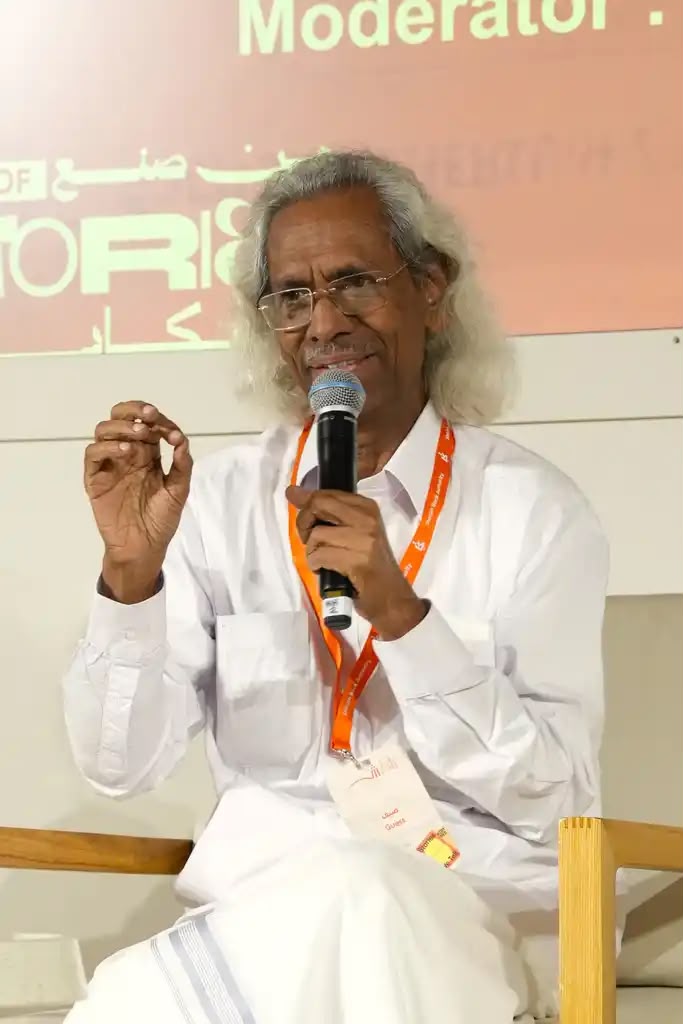
Gopi praised the Sharjah International Book Fair as evidence of visionary leadership that places literature, art, and books directly before the public. Recalling his literary journey, he noted that reading Victor Hugo’s Les Misérables in the eighth grade shaped his path as a writer.

Lyricist B.K. Harinarayanan addressed the perceived hierarchy between poetry and songwriting, asserting that neither form sits above the other. Poetry serves as personal self-expression, while song carries distinct artistic mechanics. Classical Malayalam literary milestones, from Cheeraman’s Ramacharitam to the Kannassa Ramayanam, Adhyathma Ramayanam Kilippattu, Vanchippattu, Thullalppattu, and Moyinkutty Vaidyar’s compositions, originated as songs. Cherusseri’s Krishnagatha was originally known and sung as Krishnappattu.
Addressing contemporary artistic expression, Harinarayanan noted that younger generations absorb diverse musical traditions and languages. The emergence of working-class lyricism—such as the phrase ‘sweat-stitched shirt’—and modern artists like rapper Vedan demonstrates the organic growth of modern Malayalam songwriting.
Gopi addressed rising interpersonal violence in relationships, observing that distorted concepts of romance arise when love is detached from truth. Derived from ‘Prama’ (truth), genuine love relates to spiritual truth rather than physical possessiveness, which has increasingly led to violent crimes. He expressed concern over the cultural loss of truth, rhythm, and linguistic grace.
The session was moderated by Radhakrishnan Machingal. Both writers signed books and interacted with audience members following the conclusion of the talk.