

A specialized initiative led by The Development Office traces the heritage craft from desert camel navigation to contemporary commercial design.
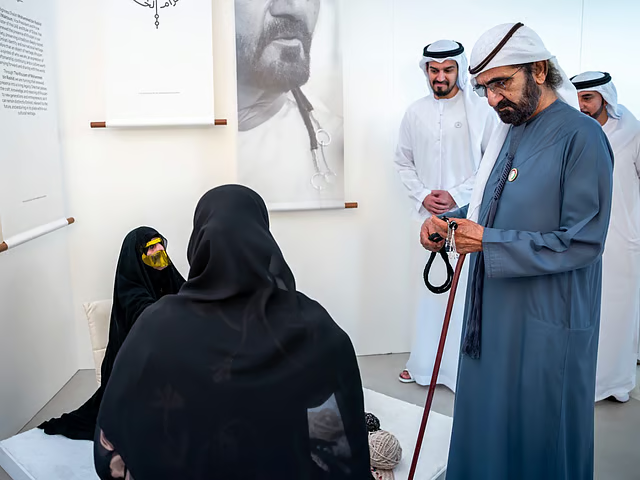
DUBAI — September 18, 2026 : His Highness Sheikh Mohammed bin Rashid Al Maktoum, Vice President and Prime Minister of the UAE and Ruler of Dubai, reviewed an extensive cultural research initiative on Friday tracing the historical path of Al Khuzam from an essential desert tool into a prominent emblem of Emirati national identity.
Sheikh Hamdan bin Mohammed bin Rashid Al Maktoum, Crown Prince of Dubai, Deputy Prime Minister, and Minister of Defence, attended the briefing alongside Sheikh Ahmed bin Mohammed bin Rashid Al Maktoum, Second Deputy Ruler of Dubai, and Mohammad Abdullah Al Gergawi, Chairman of The Executive Office of Sheikh Mohammed bin Rashid Al Maktoum.
Supervised by The Development Office, the initiative brought together a multidisciplinary team of historians, craftspeople, and contemporary designers. The project archives the physical artifact while examining how its social meaning shifted across generations, creating an economic pathway for modern Emirati entrepreneurs to adapt historic motifs into contemporary luxury goods and industrial design.

The study categorizes the evolution of Al Khuzam into three distinct epochs:
- The Functional Era: An operational tool essential for desert navigation, used directly in camel steering and control across harsh terrain.
- The Social Era: A visible lifestyle accent integrated into traditional dress, daily regional gear, and tribal trade networks.
- The Symbolic Era: A modern cultural touchstone representing endurance, self-reliance, and unified national heritage.
Researchers compiled references from classical and regional Arabic poetry, establishing that Al Khuzam often served as a metaphor for discipline, endurance, and decisive leadership. Archival records from across the wider Arab world were analyzed to trace regional variants, confirming that its aesthetic refinement attained a distinct cultural form within the Arabian Peninsula.
The preservation program also systematically maps the physical production cycle: gathering raw wool, spinning natural fibers into durable cords, hand-braiding tight ropes, and mounting functional silver rings, structural knots, and ornamental metal chains. Senior artisans contributed direct technical documentation to ensure that these intricate metalworking and textile techniques are integrated into educational curricula and vocational heritage programs.
Designers involved in the project presented prototype collections showing how the geometric knots and metallic elements of Al Khuzam can be adapted for modern luxury accessories, homeware, and architectural detailing. The initiative serves as a commercial blueprint for Emirati creatives, linking traditional material history with enterprise funding to position indigenous design elements in global retail markets.