

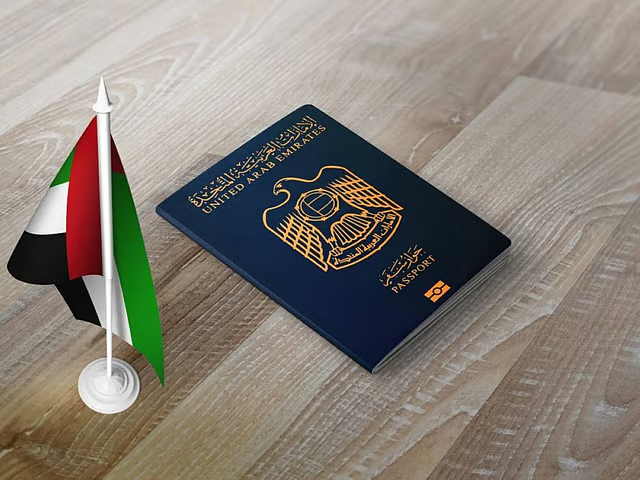
Emirati citizens secure a seven-destination lead over Singapore and Malaysia in the latest Passport Index rankings, while Britain places seventh and the United States tenth.
DUBAI, Oct. 14 : The United Arab Emirates passport has retained its position as the world’s most powerful travel document, offering citizens access to 182 destinations without requiring a standard pre-departure visa, according to updated data from Arton Capital’s Passport Index.
The latest figures, reported by the state-run Emirates News Agency (WAM), give Emirati passport holders a clear lead over contenders in Asia and Europe. Singapore and Malaysia share second position with mobility scores of 175, while Spain ranks third with access to 174 destinations.

The UAE’s total mobility score comprises 138 visa-free entry destinations and 44 locations offering simplified arrival procedures, including visas on arrival and electronic travel authorisations. Pre-arranged travel permits remain necessary for 16 destinations globally.
A substantial cluster of 17 nations occupies fourth place with scores of 173. That tier includes major European Union economies such as France, Germany, Italy, and the Netherlands, alongside Japan, Switzerland, and Norway.
Fifth place is shared by eight countries, including South Korea, Poland, and Hungary, each securing entry to 172 destinations. Romania, the Czech Republic, Bulgaria, and Lithuania followed in sixth with 171.
Traditional Western powerhouses registered lower in the global mobility standings. The United Kingdom ranks seventh alongside Cyprus with a score of 170. Canada, New Zealand, and Liechtenstein share eighth place at 169, Australia and Iceland sit ninth with 168, and the United States places tenth with 167.
The Passport Index evaluates travel documents across 193 United Nations member states and six autonomous territories: Taiwan, Macao, Hong Kong, Kosovo, the Palestinian Territory, and Vatican City. Unlike static annual indexes, the platform updates in real time whenever governments adjust visa policies or bilateral entry agreements.
Tie-breakers for countries with matching total mobility scores prioritize the proportion of strictly visa-free access over visas on arrival, with the United Nations Development Programme’s Human Development Index serving as a secondary determinant.
WAM noted that the sustained ranking underscores the country’s diplomatic outreach and international standing, supported by years of reciprocal visa-waiver negotiations led by the Ministry of Foreign Affairs.