


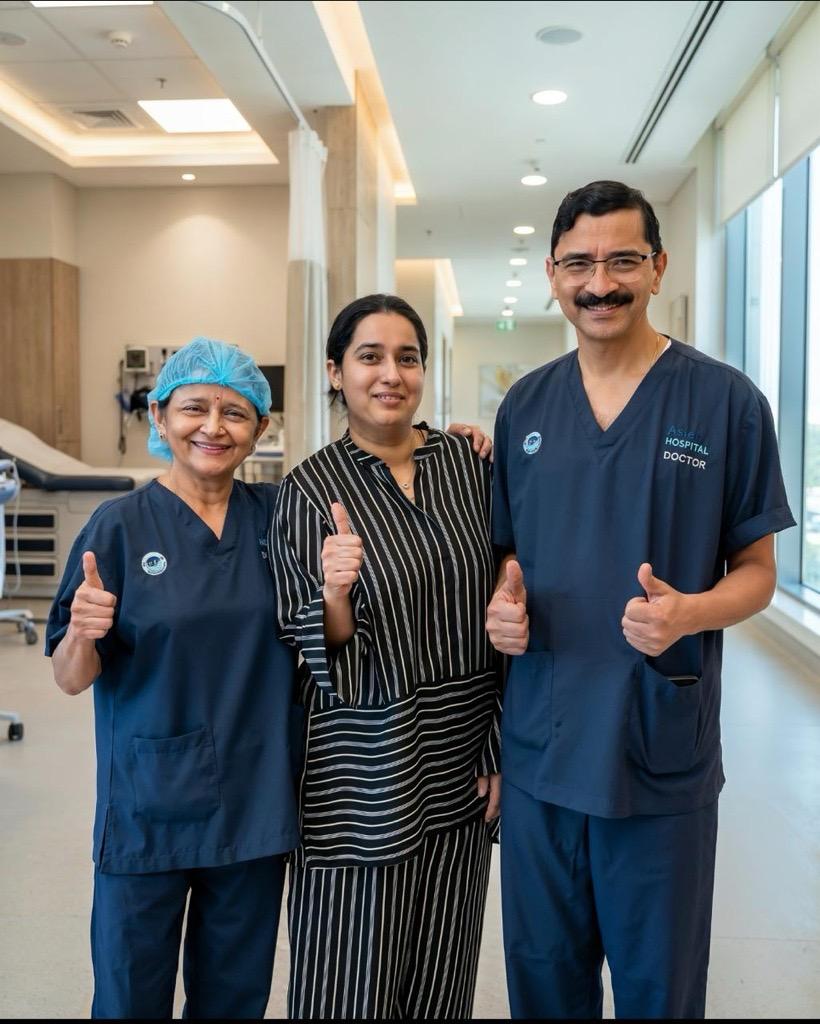
Expert cardiac team at Al Qusais successfully manages a high-risk, medically complex case on a young female patient.
DUBAI, UAE: In a medical feat highlighting exceptional surgical expertise and clinical integration, a 32-year-old female expatriate successfully underwent a rare and complex beating heart redo-bypass surgery at Aster Hospital, Al Qusais. The patient, Mahpara Ashraf, a Pakistani national residing in Dubai, presented with severe complications just six months after undergoing an initial coronary artery bypass grafting (CABG) procedure.
Mahpara’s medical profile carried high-risk factors including diabetes, hypertension, hyperlipidemia, and severe coronary artery disease. Having previously undergone a percutaneous transluminal coronary angioplasty (PTCA) with a stent in May 2025 and a subsequent bypass surgery in Pakistan in June 2025, her condition deteriorated rapidly upon her return to Dubai. She was referred to Aster Hospital, Al Qusais with unstable angina, a critical condition that could lead to a massive heart attack if left untreated.

A repeat coronary angiography (CAG) revealed severe, multiple obstructions in her native coronary arteries and near-total failure of her previous bypass grafts, with only one remaining functional. Given her continuous chest pain, emergency intervention became crucial. The medical challenge intensified as the cardiac surgical team had to operate on a beating heart while navigating the unavailability of standard blood vessels used in the first surgery, requiring them to locate alternative suitable conduits to create four new bypasses.
Redo-bypass surgeries are globally rare, accounting for less than 2% of all bypass interventions. Requiring a second open-heart procedure within a six-month window on a pre-menopausal female makes this case extraordinary. Statistically, CABG is primarily performed on men, with women representing only 20% to 30% of cases globally due to the cardioprotective effects of estrogen prior to menopause. Furthermore, female patients often face higher postoperative mortality and more severe clinical complexities compared to men.
“This was a highly challenging and rare case,” said Dr. Sandeep Srivastava, Consultant Cardiothoracic Surgeon at Aster Hospital, Al Qusais. “Performing a redo-bypass surgery on a beating heart within such a short interval demands an exceptional level of experience and surgical precision. The presence of previous grafts and the patient’s unstable status added layers of complexity. Our team meticulously planned every step, delivering a comprehensive four-graft recovery procedure that promises sustainable results.”
The patient’s postoperative recovery was remarkably smooth. Dr. Shipra Srivastava, Consultant Cardiothoracic Surgeon at Aster Hospital, Al Qusais, reiterated the rarity of the circumstance, noting that the complete obstruction of almost all previous grafts within just six months in a 32-year-old female presented a profound clinical anomaly.
Dr. Abdul Rahoof Malik, Specialist Cardiologist at Aster Hospital, Al Qusais, emphasized the broader health warnings of the case. He noted that it underscores an alarming trend of severe cardiac diseases emerging in young patients due to lifestyle conditions like diabetes, hypertension, and high cholesterol. He added that the success demonstrates how structured, team-based medical approaches can safely deliver excellent outcomes even in high-risk redo surgeries.
Expressing her gratitude, Mahpara Ashraf thanked the medical and support staff at Aster Hospital for saving her life. She stated that while she was deeply anxious when the chest pain recurred so soon after her first surgery, the confidence, meticulous care, and unwavering support of the cardiac surgical team guided her safely through her treatment and recovery.