

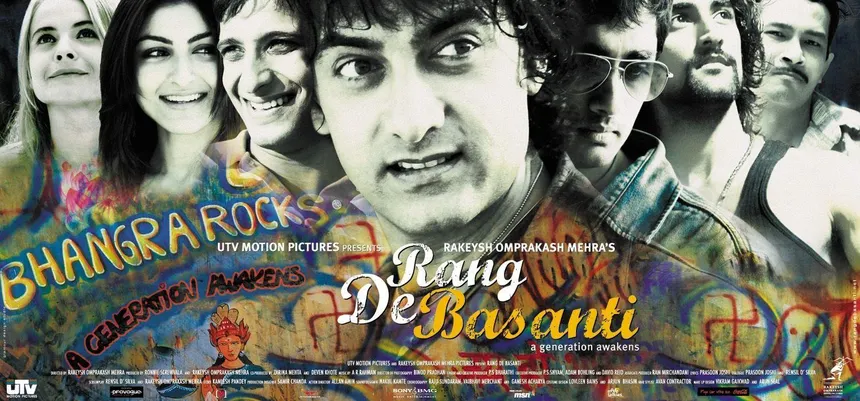
As student demonstrations at Jantar Mantar bring youth politics back into focus in 2026, Rakeysh Omprakash Mehra’s landmark film marks 20 years of challenging public apathy.
NEW DELHI —Two decades after its theatrical release, Rakeysh Omprakash Mehra’s political drama Rang De Basanti remains a defining cultural touchstone for youth mobilization, finding fresh resonance as university students and youth outfits return to protest sites across the national capital.
Student unions and civil rights groups gathering at Delhi’s historic Jantar Mantar have revived long-standing debates surrounding democratic accountability and institutional transparency. The demonstrations, which saw police detain several participants during rallies demanding structural reforms in electoral oversight, point to a familiar civic tension: how young citizens navigate power structures when established institutions face public scrutiny.
That tension formed the narrative engine of Rang De Basanti when it debuted in January 2006. Written by Kamlesh Pandey and Mehra, the film followed five carefree Delhi University graduates cast in an independent documentary directed by a British filmmaker, Sue McKinley. Portraying historical revolutionaries—Bhagat Singh, Chandrashekhar Azad, Shivaram Rajguru, Ram Prasad Bismil, and Ashfaqulla Khan—the characters gradually absorb the political convictions of the figures they dramatize, moving from detachment to radical confrontation.

The narrative pivot arrives with the death of Flight Lieutenant Ajay Rathod, an Indian Air Force pilot killed in a MiG-21 crash caused by defective imported components. When defense authorities and government ministers brand Rathod’s error as pilot negligence to conceal kickbacks, the characters collide with state corruption. The storyline mirrored actual controversies surrounding vintage military aviation hardware and defense procurement disputes that dominated Indian headlines in the late 1990s and early 2000s.
Aamir Khan’s portrayal of Daljeet “DJ” Singh grounded the film’s examination of post-academic drift. DJ clings to university life to evade unemployment and civic obligations, treating institutional decline as background noise until personal loss destroys his detachment. The character arc provided a template for understanding urban middle-class inertia: disengagement rarely stems from ignorance, but from the privilege of insulation.
Siddharth’s performance as Karan Singhania tackled an internal class fracture. As the estranged son of an industrialist profiting directly from corrupt defense contracts, Karan’s dilemma exposed the complicity of private capital in state malfeasance. His trajectory challenged the assumption that privilege insulates youth from systemic failure, forcing him to choose between inherited wealth and moral liability.
The ideological friction within the group found its clearest expression in Laxman Pandey, played by Atul Kulkarni. Initially aligned with a right-wing political party and hostile toward secular peers, Pandey’s transformation discarded dogmatism in favor of shared civil action. His character offered an alternative to polarization, illustrating how common grievances cut across sectarian divisions. Sharman Joshi’s Sukhi provided emotional vulnerability beneath comedic timing, while Kunal Kapoor’s portrayal of Aslam Khan dismantled stereotypes, showing patriotism rooted in pluralism rather than majoritarian conformity.
Behind the lens, Mehra framed Indian revolutionary history not as static museum exhibits, but as an active critique of modern governance. Cinematographer Binod Pradhan utilized contrasting color palettes—warm, sepia-drenched tones for the 1920s freedom struggle and cool, contemporary framing for modern Delhi—to blur the boundaries between colonial resistance and contemporary dissent.
The film’s sonic architecture, composed by A.R. Rahman with lyrics by Prasoon Joshi and rap sequences by BlaaZe, operated as narrative commentary rather than conventional musical interludes. Tracks such as “Loose Control” captured hedonistic abandon, while “Khalbali” mirrored gathering unrest. In “Rubaroo,” the score articulated self-realization, and Lata Mangeshkar’s duet with Rahman on “Luka Chuppi” underscored the human cost of political negligence through maternal grief.
The film’s reception across India in 2006 established what sociologists termed the “RDB Effect.” Within weeks of its release, thousands of citizens organized candlelight vigils at India Gate demanding justice in the Jessica Lal murder case, ultimately pressuring the Delhi High Court to fast-track appeals and overturn acquittals. Subsequent public inquiries into infrastructure failures, corruption watchdogs, and police conduct frequently referenced the film’s imagery.
Yet the film’s violent climax—in which the protagonists storm the All India Radio headquarters and assassinate a defense minister before being killed by commandos—remains a subject of critical debate. While it dramatized absolute disillusionment with democratic redress, modern political analysts point out that violent escalation undermines legitimate democratic reform. For contemporary youth navigating digital disinformation, algorithmic echo chambers, and complex legal realities, the critical mandate lies in sustained, peaceful civic participation: rigorous fact-checking, strategic public interest litigation, responsible voting, and institutional reform rather than desperate retaliation.
Twenty years on, Rang De Basanti endures precisely because it asks an unresolved democratic question: when state machinery fails the public interest, what is the duty of the citizen?