

Breakthrough discoveries at Jebel Al Buhais and Al Ain join new ICESCO heritage listings, shedding fresh light on early human adaptation and trade
ABU DHABI:A series of archaeological breakthroughs across the UAE in 2026 has provided fresh insight into early human survival, ancient trade networks, and regional settlement patterns spanning tens of thousands of years.
Discoveries announced by international research teams and local heritage authorities have systematically filled critical gaps in the Arabian Peninsula’s history. These findings span from deep prehistoric hunter-gatherer migrations to complex Bronze Age societies.
In Sharjah, a multi-year international study published in Nature Communications in March 2026 revealed evidence of early human occupation at the Jebel Al Buhais rock shelter dating back between 60,000 and 16,000 years. The findings challenge long-held assumptions regarding human resilience in the region, proving that ancient populations repeatedly returned to the site despite extreme climatic shifts and prolonged droughts. To further advance prehistoric research in the Emirate, a new AED 2 million research grant running from 2026 to 2028 has been allocated to Jebel Faya.

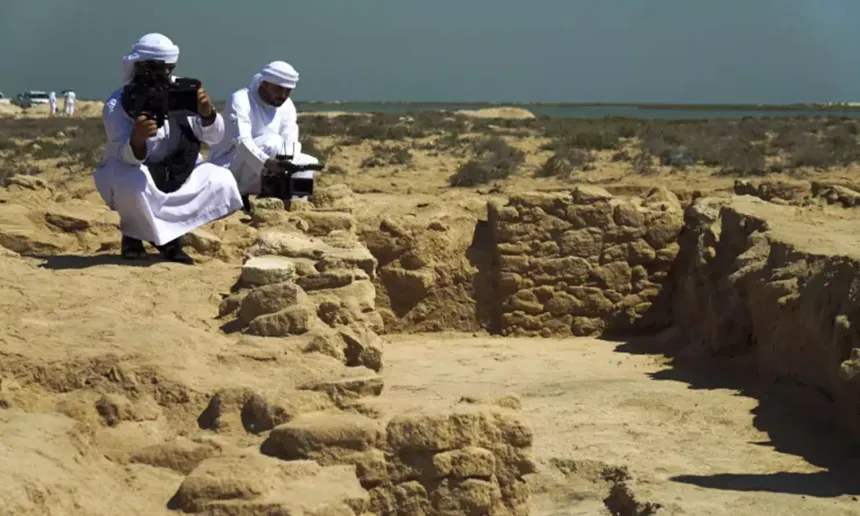
In Al Ain, the Department of Culture and Tourism – Abu Dhabi (DCT Abu Dhabi) revealed in July the discovery of a remarkably preserved collective tomb at the Qattara Archaeological Cemetery. Dating from the Wadi Suq to the Late Bronze Age (c. 2000–1300 BCE), the 11-by-2.5-metre structure was built using repurposed carved stone blocks taken from older Umm al-Nar funerary sites (c. 2700–2000 BCE).
The tomb contained the remains of hundreds of individuals interred over a thousand-year period, alongside an array of pottery, bronze weaponry, and personal ornaments. Teams of specialists are currently conducting isotopic and DNA analyses on the human remains to map ancient diets, health markers, and migration patterns across early maritime and overland trade routes. The discovery further reinforces the significance of Al Ain’s cultural sites, which have held UNESCO World Heritage status since 2011.
Global recognition for the UAE’s historical assets expanded when the Ministry of Culture confirmed the addition of five Emirati historical sites to the Islamic World Educational, Scientific and Cultural Organization (ICESCO) Heritage List.
The newly recognized sites include Dubai’s ancient metallurgical center, Saruq Al Hadid, as well as four locations in Sharjah: Jebel Faya, the historical fortifications of Khorfakkan, the Bronze Age copper-mining hub of Wadi Al Helo, and Nahwa. The rock art at Nahwa, spanning the Bronze Age to the modern era, has recently been cataloged using 3D digital imaging techniques to preserve the site for future study.